Ma nièce Janeton n'étant pas jolie, j'ai poursuivi à faire babiller la mère. Je lui ai demandé si les Parmesans étaient contents d'être devenus sujets d'un Espagnol.Je pense à l'époque les montres et horloges n'étant pas très précis, il fallait les régler tous les jours. Pour cela faire on doit s'orienter dans la nature et le coucher du soleil était un événement bien lisible à ce but. Le régime espagnol (qui était aussi le régime français à l'époque) était le plus moderne. On s'oriente au midi – l'instant ou le soleil est le plus haut de le ciel – ce qui fait que chaque jour fait exactement 24 h. Le désavantage c'était qu'il faut des instruments pour déterminer c'était instant assez précisément. Je suppose que juste cela est devenu possible à l'époque, d'où le changement de régime.
— Contents? Nous nous trouvons tous dans un vrai labyrinthe ; tout est bouleversé, nous ne savons pus où nous sommes. Heureux temps, où régnait la maison Farnèse, tu n'es plus ! [..] Nous sommes réduit à une confusion incroyable. Depuis trois mois il n'y a pus personne à Parme qui sache l'heure qu'il est.
Depuis que Dieu a fait e mode, e soleil s'est toujours couché à vingt-trois heures et demie, et à vingt-quatre on a toujours dit l'angélus ; et tous les honnêtes gens savaient qu'à cette heure-à on allumait la chandelle. Actuellement, c'est inconcevable. Le soleil est devenu fou : il se couche tous es jours à une heure différente. Nos paysans ne savent plus à quelle heure ils doivent venir au marché. On appelle cela un règlement : mais savez-vous pourquoi ? Parce qu'à présent tout le monde sait qu'on dîne à douze heures. Beau réglement ! Au temps des Farnèse on mangeait quand on avait faim et cela valait bien mieux.
1 May 2010
les mesures de temps au 18ème siècle
Dans l'Histoire de sa vie Jacques Casanova nous raconte d'une conversation qu'il ait en 1749 dans la ville de Parme en Italie. À cette époque, Philip d'Espagne et devenu duc de Parme après la mort du dernier duc de la maison Farnèse.


26 April 2010
Confession d'une femme
Depuis que je me connais, je me suis trouvée toujours transportée par la volupté amoureuse. Quand je voyais un homme, j'étais enchantée de voir l'être qui étai la moitié de mon espèce né pour moi, moi étant faite pour lui, me tardant d'y être jointe pas le nœud du mariage. Je croyais que ce qu'on appelle amour venait après l'union ; et je fus surprise que mon mari me faisant devenir femme ne m'ait fait connaître la chose que par une douleur qui ne fut compensée par aucun plaisir. J'ai trouvé que mon imagination au couvent m'était d'une plus grande ressource. Il est arrivé de là que nous ne sommes devenus que bons amis, très froids, couchant rarement ensemble, et point curieux l'un de l'autre ; malgré cela, assez d'accord, puisque quand il veut de moi je suis toujours à ses ordres ; mais comme la pitance n'est pas assaisonnée par l'amour, il la trouve insipide : aussi ne la demande-t-il que lorsqu'il croit en avoir besoin. D'abord que je me suis aperçue que tu m'aimais, j'en fus bien aise, et je t'ai fourni toutes les occasions de devenir toujours plus amoureux, sûre de mon côté que je ne t'aimerais jamais ; mais quand j'ai vu que je m'étais trompée, et que je devenais amoureuse aussi, j'ai commencé à te maltraiter, comme pour te punir de m'avoir rendue sensible. Ta patience et ta résistance m'ont étonné en même temps que fait reconnaître mon tort, et après le premier baiser je ne me suis plus trouvée maîtresse de moi-même. Je ne savais pas qu'un baiser pouvait être d'une si grande conséquence. Je fus convaincue que je ne pouvais me faire heureuse qu'en te rendant heureux. Cela m'a flattée et plu, et j'ai reconnu principalement dans cette nuit que je ne le suis qu'autant que je vois que tu l'es.extrait de: L'histoire de la vie de Jacques Casanova, écrite par lui-même à Dux en Bohème, ca. 1790, Vol. 2, chap. V–VI, p. 168
29 March 2010
the better bike odometer, part II
While my original idea in making up the bike electro-mechanic odometer described in the last past was to get rid of batteries on a bike, a friend told me that for ordinary people getting rid of the spoke sensor of the classical odometer is a much better selling point for the hub-dynamo driven odometer. Batteries in bike odometers usually last several years, so there is little pragmatic need to rid of them. I also agree with him that most people will probably prefer a digital odometer (much resembling the ones on the market now) to a mechanical one. While I still think that an electro-mechanic odometer would be a nice luxury bike component (just like Swiss mechanical watches are still a popular accessory among the rich elite), a more traditional digital odometer would be much easier (and cheaper) to make and could offer the features at the same price as state-of-the-art current odometer – just that it dispenses with the spoke-sensor and batteries.
My friend and I have come up with two ways to make a sensor-less and battery-less odometer: first is to use off-the-shelf generic components like a dot-matrix LCD and micro-controller – this allows us to build an experimental prototype at low cost as well as some practical devices for our own bike at an affordable price. We agreed to build this together just for fun!
If we ever were to commercialize it, however, we would need to drop to price to the same €20 range as current commercial models which requires custom-made components that are mass-produced with high initial investment cost. Personally I think there could be a middle way by re-using the shell and LCD of a cheap generic odometer and just replace the electronics with ours. In Europe (at least Denmark, Netherlands, Germany, Austria, and Switzerland) hub dynamos are now common place on utilitarian and travel bicycles and even on some sport bicycles. (That's because dynamo-lights are legally mandated for bikes used in public traffic and hub dynamos have replaced all other dynamos on new bikes.) Therefore the market for a spoke-sensor-free and battery-free bike odometer is huge. There are currently ca. 5 million new bikes sold in Germany each year and the amount is probably the same in the sum of the other four countries mentioned. If half of those bikes has a hub dynamo then that's 5 million potential odometer-buyers each year just in those five countries!
My friend and I have come up with two ways to make a sensor-less and battery-less odometer: first is to use off-the-shelf generic components like a dot-matrix LCD and micro-controller – this allows us to build an experimental prototype at low cost as well as some practical devices for our own bike at an affordable price. We agreed to build this together just for fun!
If we ever were to commercialize it, however, we would need to drop to price to the same €20 range as current commercial models which requires custom-made components that are mass-produced with high initial investment cost. Personally I think there could be a middle way by re-using the shell and LCD of a cheap generic odometer and just replace the electronics with ours. In Europe (at least Denmark, Netherlands, Germany, Austria, and Switzerland) hub dynamos are now common place on utilitarian and travel bicycles and even on some sport bicycles. (That's because dynamo-lights are legally mandated for bikes used in public traffic and hub dynamos have replaced all other dynamos on new bikes.) Therefore the market for a spoke-sensor-free and battery-free bike odometer is huge. There are currently ca. 5 million new bikes sold in Germany each year and the amount is probably the same in the sum of the other four countries mentioned. If half of those bikes has a hub dynamo then that's 5 million potential odometer-buyers each year just in those five countries!
21 March 2010
a reliable and sleek bicycle odometer

Knowing how far you've gone is very useful when cycling. It can help you find your way with the help of a map (for ex. to “turn right after 1.5 km”), find which of a set of alternative routes is shorter, know how much workout you had, and estimate how far you still have to go on your trip. A classical odometer offers two counters, one resettable “trip” counter and one non-resettable “lifetime” counter, both having their own scale. The odometer proposed here shows just those two counters in the form of black digits printed on a white background, the digits sliding behind a little window. This has the advantage of being very readable, high-contrast, good-looking, robust and not using any power to display the numbers. The counting up is done using impulses from the bicycles hub dynamo and uses almost no power from the wheels. Resetting the trip counter is done mechanically with the user's gesture being the power-source. This construction ensures that the counter always displays the current mileage and is resettable even when the bike is not running or has not been running for a long time.
Here are some advantages of the proposed odometer:
- high readability, always-on display
- ease of use with only one dial (or button) to reset the counter
- no parts attached to the bike wheels; only a small cable branching of the lighting system
- no battery needed, therefore no need to swap batteries
- very little energy use which does not noticeably increase the loss power of a normal hub dynamo
- handle-bar mounting in-between brake lever and grips for sleek design, robustness, and discouraging theft
 Here's a very sketchy drawing of how the odometer integrates with the handlebars. The top line shows XXX.X km and the bottom XX XX0 km.
 And here some more detailed design information: the trip counter has four digits, the smallest counting 100 m. The life-time counter also has four digits with the smallest counting each 10 km. The longest trip will therefore be 999.9 km, which has been chosen because some people ride more than 100 km in a day and other might want to count trips of more than a day. The life-time counter will relapse to 0 after showing 99'990 km which is enough for most bicycles, although not enough for people who really ride a lot and keep the bike for more than a decade. (For an example see Rohloff Wanted day.) For those people there will be a luxury version of the counter with two times five digits: the trip counter measures each 10 m and the life-time counter goes up to 999'990 km. I would think that some people would buy this extended counter just to show off how far their bike is designed to go!
A variant with speedometer would use a classical needle to show the bike's current speed on a scale and it would additionally have a counter for the time of the current trip (accumulated time with speed >0). Then a second needle would show the average speed of the trip (which is the dividend of trip length and trip time so far). This second needle would be held in place with a gearing mechanism that doesn't need any power either. So when you stop the bike, the current speed will drop to 0 and stay there while the average will just stay where it was. When you sleep during a cold night that would drain any batteries and come back the next morning, the needle will still show your trip's average speed. I think that's reliability! And that's cool!
PS: Germersheim, I come!
18 March 2010
U-Bahn Zürich
Zürich gilt unter Verkehrsexperten als leuchtendes Beispiel für guten öffentlichen Nahverkehr, nicht zuletzt weil sich die Bürger in den 70er Jahren explizit gegen eine U-Bahn entschieden und damit das sehr benutzerfreundliche Tramnetzwerk erhielten. Andrew Moglestue hat eine interessante Zusammenfassung der Züricher Projekte für Tram-Tunnel (aus den 60ern) und U-Bahn (aus den 70ern).
Manche glauben auch, dass Zürich damals eine einmalige Chance verpasst hat, eine U-Bahn einzuführen. Hat Zürich seine Zukunft verspielt? Dazu findet sich ersten Teil von Andrews Zürich: A city and its trams folgendes schönes Zitat: „Zürich's tram system has acquired an iconic status; 65% of people commuting within the city do so by public transport, with only 17% using cars [1].“ Dazu kann ich nur folgende einfache Frage stellen: welche Stadt, die eine U-Bahn hat, erreicht solch traumhafte Werte? In Westeuropa und Nordamerika kenne ich keine. In Asien gibt es das vielleicht, aber mit Peking und Manila will sich Zürich lieber nicht vergleichen.
Die eher kleine Stadt Zürich hätte gern eine U-Bahn, um sich mit Stuttgart, München oder Wien vergleichen zu können. In dieser Größenordnung liegt Zürich – trotz seiner internationalen Bedeutung als Bankenzentrum und Shoppingvillage für neureiche Russen – nun mal aber nicht. Ein besserer Vergleich mögen die Städte Karlsruhe und Mannheim sein. Außerdem ist zu sehen, dass im Großraum Zürich nur ein Drittel der ca. eine Mio. Einwohner in Zürich selbst leben und zwei Drittel im Umland. In deutschen Großstädten ist das Verhältnis umgekehrt. In Berlin wohnt wohnen drei Viertel der Großraumbewohner in der Stadt selbst. (Und vom Rest viele allein in der Stadt Potsdam.) In München sind es immer noch mehr als die Hälfte. Nur Stuttgart hat ein zu Zürich ähnliches Verhältnis von Stadt und Umland. Dabei ist Stuttgart aber immer noch zwei bis drei Mal so groß.
Zuguterletzt sei nicht verschwiegen, dass auch in Zürich noch Optionen für Tram-Tunnel bestehen. So gibt es am Hauptbahnhof eine U-Bahn-Station aus den 70er Jahren, die zur Zeit für zwei S-Bahn-Linien benutzt wird, von denen eine (die Uetlibergbahn) das gleiche Stromsystem wie die Züricher Straßenbahn verwendet. Es ist also durchaus möglich, dass in dieser Station irgendwann einmal die Uetlibergbahn und Straßenbahn gemeinsam verkehren. So wie das die Forchbahn bereits tut.
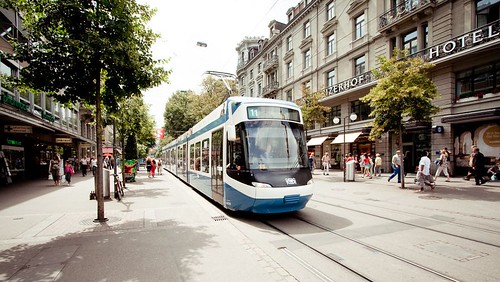 |
| Moderne Straßenbahn in der Innenstadt von Zürich. Man bemerke, dass diese Straße auch eine Fußgängerzone ist. |
Manche glauben auch, dass Zürich damals eine einmalige Chance verpasst hat, eine U-Bahn einzuführen. Hat Zürich seine Zukunft verspielt? Dazu findet sich ersten Teil von Andrews Zürich: A city and its trams folgendes schönes Zitat: „Zürich's tram system has acquired an iconic status; 65% of people commuting within the city do so by public transport, with only 17% using cars [1].“ Dazu kann ich nur folgende einfache Frage stellen: welche Stadt, die eine U-Bahn hat, erreicht solch traumhafte Werte? In Westeuropa und Nordamerika kenne ich keine. In Asien gibt es das vielleicht, aber mit Peking und Manila will sich Zürich lieber nicht vergleichen.
 |
| Zwei S-Bahn-Züge in Zürich Stadelhofen |
Die eher kleine Stadt Zürich hätte gern eine U-Bahn, um sich mit Stuttgart, München oder Wien vergleichen zu können. In dieser Größenordnung liegt Zürich – trotz seiner internationalen Bedeutung als Bankenzentrum und Shoppingvillage für neureiche Russen – nun mal aber nicht. Ein besserer Vergleich mögen die Städte Karlsruhe und Mannheim sein. Außerdem ist zu sehen, dass im Großraum Zürich nur ein Drittel der ca. eine Mio. Einwohner in Zürich selbst leben und zwei Drittel im Umland. In deutschen Großstädten ist das Verhältnis umgekehrt. In Berlin wohnt wohnen drei Viertel der Großraumbewohner in der Stadt selbst. (Und vom Rest viele allein in der Stadt Potsdam.) In München sind es immer noch mehr als die Hälfte. Nur Stuttgart hat ein zu Zürich ähnliches Verhältnis von Stadt und Umland. Dabei ist Stuttgart aber immer noch zwei bis drei Mal so groß.
 |
| Tram-Stau in Toronto. Wenn es in Zürich so aussähe wäre wohl eine U-Bahn gerechtfertigt. |
Zuguterletzt sei nicht verschwiegen, dass auch in Zürich noch Optionen für Tram-Tunnel bestehen. So gibt es am Hauptbahnhof eine U-Bahn-Station aus den 70er Jahren, die zur Zeit für zwei S-Bahn-Linien benutzt wird, von denen eine (die Uetlibergbahn) das gleiche Stromsystem wie die Züricher Straßenbahn verwendet. Es ist also durchaus möglich, dass in dieser Station irgendwann einmal die Uetlibergbahn und Straßenbahn gemeinsam verkehren. So wie das die Forchbahn bereits tut.
Subscribe to:
Posts (Atom)